Autodesk has promoted Design Consulting to an Autodesk Gold Partner following continued growth since becoming an Autodesk Reseller in November, 2020.
Design Consulting would like to thank our customers, staff and Autodesk for all their support as we move at the speed of business!
Design Consulting provides tailored end to end solutions, expertise and specialisation in Autodesk’s offerings, aligning our solutions with our customers objectives and good old fashioned customer service.
Contact us to find out how we can help your business. Fill out the form below, by live chat, phone or email.
P: 1800 490 514 | E: info@designconsulting.com.au
autocad architecture vs autocad lt, AutoCAD LT vs AutoCAD architecture
AutoCAD and AutoCAD Architecture are both powerful CAD software programs that can be used for a variety of purposes, including architectural design, engineering, and manufacturing. However, there are some key differences between the two programs that can make one a better choice for your specific needs.
In this blog post, we will compare AutoCAD and AutoCAD Architecture in terms of their features, capabilities, and pricing. We will also discuss the factors you should consider when choosing between the two programs.
AutoCAD is a general-purpose CAD software program that can be used for a variety of purposes, including architectural, mechanical, and electrical design. It offers a wide range of features and tools, making it a versatile option for many different industries.
Some of the key features of AutoCAD include:
AutoCAD is a general-purpose CAD software program that can be used to create 2D and 3D drawings. It includes a wide range of features for drafting, editing, and annotating drawings. AutoCAD also supports a variety of file formats, making it easy to share your drawings with others.
AutoCAD Architecture is a specialized CAD software program that is designed for architectural design. It includes a number of features that are specifically designed for creating architectural drawings, such as intelligent walls, doors, and windows. AutoCAD Architecture also includes a library of pre-built architectural objects, which can save you time and effort when creating your drawings.

Both AutoCAD and AutoCAD Architecture are capable of creating high-quality drawings. However, AutoCAD Architecture has a number of features that make it specifically suited for architectural design. These features include:

| Feature | AutoCAD Architecture | AutoCAD | AutoCAD LT |
|---|---|---|---|
| Intelligent objects | Yes | No | No |
| Architectural features | Yes | No | No |
| Parametric modeling | Yes | No | No |
| 2D drafting tools | Yes | Yes | Yes |
| 3D modeling tools | Yes | Yes | No |
| Annotation tools | Yes | Yes | Yes |
| Rendering tools | Yes | Yes | No |
| Schedules | Yes | No | No |
| Documentation tools | Yes | Yes | No |
| Standards compliance | Yes | No | No |
| Collaboration tools | Yes | Yes | No |
| Cloud integration | Yes | Yes | No |
AutoCAD Architecture has a number of unique commands that are specifically designed for architectural design. These commands include:
In addition to these unique commands, AutoCAD Architecture also includes a number of other features that are specifically designed for architectural design. These features include:
Choosing between AutoCAD and AutoCAD Mechanical? Our free eBook offers a detailed comparison to help you make the best choice for your design projects. Gain insights into key features, pricing, and real-world applications.
Download the eBook now to make an informed decision and optimise your workflow.
Organisations can customise AutoCAD for their industries, empowering teams to build and run discipline-specific routines and workflows.
Download the Study here to learn how you can save over 60% in productivity using AutoCAD with Specialised Toolsets.
Contact us to find out how much money you can save on software, training or other services. Fill out the form below, by live chat, phone or email.
P: 1800 490 514 | E: info@designconsulting.com.au
autocad architecture vs autocad lt, AutoCAD LT vs AutoCAD architecture
AutoCAD Map 3D is a powerful GIS software that allows CAD professionals to create, edit, and visualize geospatial data. It is a comprehensive toolset that includes everything you need to work with maps, 3D models, and other spatial data.
AutoCAD Map 3D is a geographic information system (GIS) software that is part of the AutoCAD family of products. It is designed for CAD professionals who need to work with geospatial data. AutoCAD Map 3D includes a comprehensive toolset for creating, editing, and visualizing maps, 3D models, and other spatial data.
AutoCAD Map 3D includes a wide range of features for working with geospatial data, including:
There are many benefits to using AutoCAD Map 3D, including:
AutoCAD Map 3D is a more powerful and feature-rich version of AutoCAD than AutoCAD LT and AutoCAD. AutoCAD Map 3D includes all of the features of AutoCAD LT and AutoCAD, plus a number of additional features for working with geospatial data.
| Feature | AutoCAD Map 3D | AutoCAD LT | AutoCAD |
|---|---|---|---|
| Data management | Yes | No | No |
| 2D and 3D drafting | Yes | Yes | Yes |
| Visualization | Yes | No | No |
| Analysis | Yes | No | No |
| Collaboration | Yes | No | No |
The right version of AutoCAD for you depends on your specific needs. If you only need to:
AutoCAD Map 3D can be used with other Autodesk apps to create a more comprehensive and integrated workflow. For example, AutoCAD Map 3D can be used with AutoCAD Civil 3D to create 3D models of infrastructure projects. AutoCAD Map 3D can be used with Autodesk 3ds Max to create photorealistic renderings of maps and models.
AutoCAD Map 3D can be connected to a variety of GIS mapping data sources, including:
To connect AutoCAD Map 3D to a GIS mapping data source, you can use the following steps:
Once you have connected AutoCAD Map 3D to a GIS mapping data source, you can view and edit the data in AutoCAD Map 3D. You can also use AutoCAD Map 3D to perform spatial analysis on the data.
Here are some of the benefits of connecting AutoCAD Map 3D with GIS mapping data sources:
If you need to work with geospatial data, then connecting AutoCAD Map 3D with GIS mapping data sources is a great way to improve your workflow and productivity.
Organisations can customise AutoCAD for their industries, empowering teams to build and run discipline-specific routines and workflows.
AutoCAD Map 3D 2024 supports the new coordinate systems in the following categories:
Refer to the 2024 Help file for further information
Choosing between AutoCAD and AutoCAD Mechanical? Our free eBook offers a detailed comparison to help you make the best choice for your design projects. Gain insights into key features, pricing, and real-world applications.
Download the eBook now to make an informed decision and optimise your workflow.
Discover how Autodesk AutoCAD 2024 can streamline your workflow, increase productivity, and optimise your design process.
Contact us to find out how much money you can save on software, training or other services. Fill out the form below, by live chat, phone or email.
P: 1800 490 514 | E: info@designconsulting.com.au
AutoCAD and AutoCAD Mechanical are both powerful CAD software programs that can be used for a variety of purposes. However, there are some key differences between the two programs that may make one a better fit for your needs than the other.
In this blog post, we will compare AutoCAD and AutoCAD Mechanical in detail. We will discuss the features, interface, pricing, and best uses of each program. By the end of this post, you will be able to decide which CAD software is right for you.
AutoCAD is a general-purpose CAD software program that can be used for a variety of purposes, including architectural, mechanical, and electrical design. It offers a wide range of features and tools, making it a versatile option for many different industries.
Some of the key features of AutoCAD include:
AutoCAD Mechanical is a specialised CAD software program that is specifically designed for mechanical engineering design. It includes a number of features and tools that are specifically useful for mechanical engineers, such as tools for creating and dimensioning parts, as well as tools for generating bills of materials.
Some of the key features of AutoCAD Mechanical include:

There are a number of key differences between AutoCAD and AutoCAD Mechanical. These differences include:
AutoCAD LT and AutoCAD Mechanical are both CAD software programs that can be used for drafting, designing, and documenting. However, there are some key differences between the two programs.
AutoCAD LT is a 2D drafting and design software program that is designed for general engineering and drafting purposes. It includes a wide range of features and tools for creating and editing 2D drawings, as well as for dimensioning, annotating, and rendering drawings. AutoCAD LT is a less expensive option than AutoCAD Mechanical, and it is a good choice for users who need a 2D drafting and design software program for general engineering and drafting purposes.
AutoCAD Mechanical is a 2D and 3D drafting, designing, and documentation software program that is specifically designed for mechanical engineering. It includes a wide range of features and tools for creating and editing 2D and 3D drawings, as well as for dimensioning, annotating, and rendering drawings. AutoCAD Mechanical also includes a library of standard parts and components, as well as tools for creating bills of materials, generating 3D printing files, and performing analysis and simulation. AutoCAD Mechanical is a more expensive option than AutoCAD LT, but it is a good choice for users who need a 2D and 3D drafting, designing, and documentation software program for mechanical engineering.

| Feature | AutoCAD LT | AutoCAD Mechanical |
|---|---|---|
| Features | 2D drafting and design | 2D and 3D drafting, designing, and documentation |
| Interface | General-purpose interface | Specialized interface designed for mechanical engineers |
| Pricing | Less expensive | More expensive |
| Best for | General engineering and drafting | Mechanical engineering |
Inventor to AutoCAD Mechanical
There are two ways to import 3D models into AutoCAD Mechanical:
If the model changes in Inventor, the changes will be updated in AutoCAD Mechanical if the following conditions are met:
If these conditions are not met, the changes will not be updated in AutoCAD Mechanical.
Here are some additional things to keep in mind when importing 3D models into AutoCAD Mechanical:
By following these steps, you can import 3D models into AutoCAD Mechanical and keep the models up to date with changes made in Inventor.

AutoCAD Mechanical to Inventor
Inventor has a feature called AnyCAD that allows you to import and work with 2D DWG files in Inventor part, assembly, and drawing environments. AnyCAD is a powerful tool that can help you to save time and improve the efficiency of your design workflow.
To import a 2D DWG file into Inventor, follow these steps:
The DWG file will be imported into Inventor as a Reference Model. Reference Models are special types of Inventor models that are linked to the original DWG file. Any changes that you make to the DWG file will be automatically updated in the Reference Model in Inventor.
Here are some additional things to keep in mind when importing 2D DWG files into Inventor:
By following these steps, you can import 2D DWG files into Inventor and keep the files up to date with changes made to the original DWG file.
Here are some additional benefits of using AnyCAD:
AnyCAD is a powerful tool that can help you to save time and improve the efficiency of your design workflow. If you are working with 2D DWG files, I encourage you to try using AnyCAD in Inventor.
The best CAD software for you depends on your specific needs. If you are a mechanical engineer who needs specialized tools for mechanical engineering design, then AutoCAD Mechanical is the better choice. If you are a general engineer or designer who needs a more versatile CAD software program, then AutoCAD is the better choice.
Mechanical CAD software is designed for the design of mechanical parts and assemblies. It does not offer the same level of features as AutoCAD Plant 3D for plant design, such as:
AutoCAD Plant 3D and P&ID tools:
Autodesk Inventor and SolidWorks Pipe and Tubing Tools:
Choosing between AutoCAD and AutoCAD Mechanical? Our free eBook offers a detailed comparison to help you make the best choice for your design projects. Gain insights into key features, pricing, and real-world applications.
Download the eBook now to make an informed decision and optimise your workflow.
Organisations can customise AutoCAD for their industries, empowering teams to build and run discipline-specific routines and workflows.
Contact us to find out how much money you can save on software, training or other services. Fill out the form below, by live chat, phone or email.
P: 1800 490 514 | E: info@designconsulting.com.au
AutoCAD Plant 3D is a powerful toolset for plant design. It offers a wide range of features that are specifically designed for the needs of plant designers and engineers. These features include:
In this blog we’ll explore the differences in using the AutoCAD Plant 3D Toolset over:
AutoCAD LT is a less expensive version of AutoCAD that is designed for 2D drafting and design. It does not offer the same level of features as AutoCAD Plant 3D, including:
AutoCAD is a more powerful version of AutoCAD LT that offers a wider range of features. However, it does not offer the same level of specialization for plant design as AutoCAD Plant 3D. AutoCAD Plant 3D includes features that are specifically designed for plant design, such as:
Mechanical CAD software is designed for the design of mechanical parts and assemblies. It does not offer the same level of features as AutoCAD Plant 3D for plant design, such as:
AutoCAD Plant 3D and P&ID tools:
Autodesk Inventor and SolidWorks Pipe and Tubing Tools:
BIM software is designed for the design and construction of buildings. It offers a wide range of features for 3D modeling, clash detection, and quantity takeoff. However, it does not offer the same level of features as AutoCAD Plant 3D for plant design, such as:
BIM software such as Revit is designed for the design and construction of buildings. It offers a wide range of features for 3D modeling, clash detection, and quantity takeoff. However, it does not offer the same level of features as AutoCAD Plant 3D for plant design, such as:
AutoCAD Plant 3D Piping Tools
Revit MEP Piping Tools:
Autodesk Revit and Fabrication Products (Estmep, CADmep and CAMduct) Integration
Revit MEP can connect to Autodesk fabrication products such as ESTmep, CADmep, and CAMduct:
The Revit MEP can connect to these Autodesk fabrication products through the Autodesk Fabrication Connector. The Autodesk Fabrication Connector is a plugin that allows Revit MEP to export models and data to ESTmep, CADmep, and CAMduct. This allows Revit MEP users to take advantage of the fabrication capabilities of these products.
Here are some of the benefits of connecting Revit MEP to Autodesk fabrication products:
To get the most out of Plant 3D, it is recommended to setup Plant 3D and P&ID templates, catalogs and specs and do training. Whether it’s software, training, setup or something custom, Design Consulting has the capabilities to achieve your objectives.
Choosing between AutoCAD and AutoCAD Mechanical? Our free eBook offers a detailed comparison to help you make the best choice for your design projects. Gain insights into key features, pricing, and real-world applications.
Download the eBook now to make an informed decision and optimise your workflow.
Organisations can customise AutoCAD for their industries, empowering teams to build and run discipline-specific routines and workflows.
The Ortho Table Setup dialog box includes simplified options and more table capabilities for orthographic drawings. You can now add the Bill of Materials (BOM) for piping, equipment, steel, as well as nozzle and spool lists into ortho drawings.
The Edit Parts and Edit Properties functions are enhanced in both Spec and Catalog Editors.
Edit parts within a selected parts family for inclusion in a spec sheet or catalog.
Refer to the 2024 Help file for further information
View all parts available for a specific size in the selected spec. Use the search box to look for specific components in the Pipe Spec Viewer.
Any changes to the size and spec lists are both updated in Pipe Spec Viewer and the Part Insertion panel on the ribbon.
In this release, ortho single-line piping offers more enhancements including a new interface for some piping criteria providing better control when you display piping in a single-line representation in orthographic drawings.
Contact us to find out how much money you can save on software, training or other services. Fill out the form below, by live chat, phone or email.
P: 1800 490 514 | E: info@designconsulting.com.au
AutoCAD® allows users to achieve a level of productivity for design creation that is not matched with AutoCAD LT®.
Autodesk commissioned a study that explored the productivity and commercial differentiations between AutoCAD and AutoCAD LT when performing tasks ranging from creating geometry to creating plans and elevations, extracting object data, and applying and monitoring CAD standards.
Results showed that AutoCAD could allow a user to generate designs up to 3.9 times quicker* compared with AutoCAD LT, when these tasks were performed by an experienced AutoCAD user.
Parametric constraints – Time savings with AutoCAD up to 33%. AutoCAD offers complete geometric and dimensional constraint creation, editing, and management of parametric constraints.
Plans and elevations – Time savings with AutoCAD up to 46%. The 3D modeling tools in AutoCAD allow for easy manipulation to generate 2D plan and elevation objects.
Isometric drafting – Time savings with AutoCAD up to 61%. AutoCAD makes it easy to view 3D objects in isometric views and has visual styles that can be set to hide hidden detail.
Data extraction – Time savings with AutoCAD up to 90%. AutoCAD provides the functionality to extract data and create tables automatically, either in the drawing or in a Microsoft Excel® file.
CAD standards – Time savings with AutoCAD up to 81%. AutoCAD provides CAD standard functionality with a highly efficient method of checking standards against new and existing DWG files.
Text edting (Express Tools) – Time savings with AutoCAD up to 80%. AutoCAD includes Express Tools with advanced workflows when changing and manipulating text.
AutoLISP – Time savings with AutoCAD up to 50%. AutoLISP functionality is available in AutoCAD and AutoCAD LT. Direct access to AutoLISP editors only from AutoCAD
saves time when editing the application.
Markup Import and Markup Assist – Time savings with AutoCAD up to 71%. Using machine learning, AutoCAD can interpret handwritten annotation and suggest conversions to AutoCAD objects, saving time and reducing errors.
Smart Blocks: Placement and Replacement – Time savings with AutoCAD up to 40%.
The Smart Blocks: Replacement tool in AutoCAD provides a simple interface where multiple blocks can be selected and replaced by a chosen block in one operation.
Application programming interface (API) and
the app store – AutoCAD offers an API not available in AutoCAD LT that allows users to automate tedious and time-consuming tasks. AutoCAD users are also able to purchase and download apps in the Autodesk App Store and develop apps to benefit
AutoCAD users on your team.
Organisations can customise AutoCAD for their industries, empowering teams to build and run discipline-specific routines and workflows.
AutoCAD LT now includes AutoLISP.
Leverage thousands of previously written programs created for use in AutoCAD-based programs. AutoCAD LT supports AutoLISP Source (LSP) files, compiled LSP files, Fast-load AutoLISP (FAS), and Visual LISP Applications (VLX) files.
Faster cross-platform markup workflows through expanded machine learning capabilities & essential experience improvements
AutoCAD 2024 offers more advanced features for 3D modeling, customisation with add-on apps and APIs, rendering, and CAD standards, among other features, while AutoCAD LT 2024 is a more affordable version that still offers many of the essential features for 2D drafting, annotation, and automation.
| Features | AutoCAD 2024 | AutoCAD LT 2024 |
|---|---|---|
| Find and replace blocks based on other blocks in your drawing | Yes | No |
| Stay informed of relevant file changes with details of multi-user activities in a DWG file | Yes | No |
| Utilise AutoLISP programs to automate repetitive tasks and enhance workflows | Yes | Yes |
| Extend AutoLISP programs with third-party automation libraries, and utilize specialised editors to write and debug programs | Yes | No |
| Create and edit 2D geometry | Yes | Yes |
| Annotate drawings with traces, text, dimensions, leaders & tables | Yes | Yes |
| Customize the ribbon and tool palettes | Yes | Yes |
| Attach and import data from PDF files | Yes | Yes |
| Share and use data from DGN files, Navisworks, & Bing Maps | Yes | Yes |
| Create and edit 3D models with solids, surfaces, & mesh objects | Yes | No |
| Customize with add-on apps and APIs | Yes | No |
| Extract object data to tables | Yes | No |
| Create renderings with lighting, materials, & visual styles | Yes | No |
| Apply and monitor CAD standards | Yes | No |
| Automate counting objects and blocks | Yes | Yes |
| Share drawings with colleagues directly from AutoCAD or AutoCAD LT | Yes | Yes |
| Import feedback and incorporate changes with a click of a button | Yes | No |
| Learn new features and workflows to work faster with My Insights | Yes | No |
With AEC3DPRINT command, you can natively export the AEC objects to an STL file format that’s compatible with 3D printing without converting to 3D solids.
New MVBlocks and block references are available in Design Center.
More than 200 new MVBlocks and block references are added to the AutoCAD Architecture (US Imperial) and AutoCAD Architecture (US Metric) content packs for Design Center. The added content is available in metric profile for non-English languages. The content includes external lighting, bathroom accessories, furniture, site, kitchen fittings, and more.
Refer to the 2024 Help file for further information
The section line symbol within AutoCAD Mechanical is updated to support the AWS Y14.3 – 2012 standard revision. To support AWS Y14.3 – 2012, all aspects of the section line symbol are revised to correspond with AWS Y14.3 – 2012.
AutoCAD Mechanical continues to support the AWS Y14.3 – 2003 standard revision to allow documents created in previous releases to be opened, edited, and saved without updating the section line symbol standard. By supporting AWS Y14.3 – 2012 and AWS Y14.3 – 2003, you can annotate new and as-built designs using the required standard revision.
The taper and slope symbol within AutoCAD Mechanical is updated to support the ISO 3040:2016(E) standard revision. To support the ISO 3040:2016(E), all aspects of the taper and slope symbol is revised to correspond with ISO 3040:2016(E).
AutoCAD Mechanical continues to support the ISO 3040:2009(E) standard revision to allow documents created in previous releases to be opened, edited, and saved without updating the taper and slot symbol standard. By supporting ISO 3040:2016(E) and ISO 3040:2009(E), you can annotate new and as-built designs using the required standard revision.
Refer to the 2024 Help file for further information
The Ortho Table Setup dialog box includes simplified options and more table capabilities for orthographic drawings. You can now add the Bill of Materials (BOM) for piping, equipment, steel, as well as nozzle and spool lists into ortho drawings.
The Edit Parts and Edit Properties functions are enhanced in both Spec and Catalog Editors.
Edit parts within a selected parts family for inclusion in a spec sheet or catalog.
Refer to the 2024 Help file for further information
View all parts available for a specific size in the selected spec. Use the search box to look for specific components in the Pipe Spec Viewer.
Any changes to the size and spec lists are both updated in Pipe Spec Viewer and the Part Insertion panel on the ribbon.
In this release, ortho single-line piping offers more enhancements including a new interface for some piping criteria providing better control when you display piping in a single-line representation in orthographic drawings.
AutoCAD Map 3D 2024 supports the new coordinate systems in the following categories:
Refer to the 2024 Help file for further information
Create a schematic symbol table from schematic reports.
The schematic report lists the symbols used in the project along with its description in a table. You can also surf through a particular symbol that is used in various locations of the project.
Wire type can now be synchronized for all wires in the network with the same signal code across the drawings.
In previous releases, when you update the type of the wire connected to the source arrows, the destination wire type was not updated. In AutoCAD Electrical 2024 toolset, when the wire type is updated at the source arrow, all wires in the network are updated to the same wire type of the source. New wire layers are created along with its properties if the destination drawing doesn’t contain the new wire type.
Refer to the 2024 Help file for further information
Choosing between AutoCAD and AutoCAD Mechanical? Our free eBook offers a detailed comparison to help you make the best choice for your design projects. Gain insights into key features, pricing, and real-world applications.
Download the eBook now to make an informed decision and optimise your workflow.
Discover how Autodesk AutoCAD 2024 can streamline your workflow, increase productivity, and optimise your design process.
Contact us to find out how much money you can save on software, training or other services. Fill out the form below, by live chat, phone or email.
P: 1800 490 514 | E: info@designconsulting.com.au
Autodesk Inventor Professional 2024 is out with a focus on new features and over 100 customer driven enhancements for MBD, Part Modeling, Assembly, Drawings, Graphics, Performance, iLogic, Content Center and the API.
Here’s the top features and enhancements in Autodesk Inventor Professional 2024.
It is now possible to set Perspective With Ortho Faces as the default view setting in both Document Settings and Application options.
Application Options:
Modeling document:
Render Size Limit Removed
Inventor Studio has had, until now, an imposed 4096 x 4096 pixel rendering output. The limitation has been removed and Inventor Studio will render images up to 16K x 16K resolution, depending on what your graphics card supports.
Custom Environment Image Support
The workflow for using custom hdr and exr images with IBL lighting styles is much improved and is supported for both CPU and GPU ray tracing.
Support for IBL backgrounds
GPU ray tracing now supports rendering with IBL backgrounds.
The following enhancements in Graphics have been added:
Text and Boolean values can now be exported
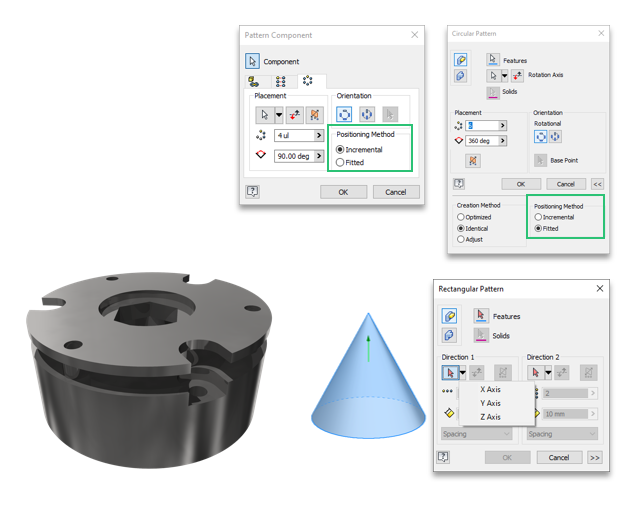
Rectangular Pattern
You can now select a revolved face, cylindrical or conical, to define the direction for a component pattern. The Pattern Component command uses the face axis to define the pattern direction. Use the standard controls to flip the direction.
It is not necessary to activate the selector when using an origin axis, clicking the flyout activates the selector and chooses the selected axis. The direction selection does not change with the activation of the selector, you must also select a new direction.
Circular Pattern
Circular pattern for components is enhanced to provide incremental and fitted positioning methods.
The new Finish feature enables you to not only specify the appearance of your parts, components and assemblies, but also the manufacturing process such as material coating or surface finish.
All applied finishes are listed in a new Finishes folder in the browser. You can re-order the finishes in the browser node, suppress, rename or delete them.
In Drawings, a new “Parameters – Finish” type category is added to the Leader Text and the Format Text dialogs to enable Finish information to be used in drawing notes. These parameters will automatically be updated if changed in the modelling environment. This enhances your drawing by adding additional manufacturing process information to the documentation.
Each Finish feature setting has a parameter with corresponding unique name in the “Finish Parameters” category in the Parameters dialog. All Finish parameters can be exported. Exported parameters are displayed in iProperties. Note that change in iProperties doesn’t affect the model finish feature parameters.
The Finish feature can be captured in Model States, iPart an iAssembly.
3D Weld Symbols
3D weld symbols are now available as one of the 3D annotation types. Create and edit weld and subweld symbols in a part or assembly model. Then, retrieve the associative symbols in drawings. 3D weld symbols are included in exports to 3D PDF, DWF, and Shared Views.
3DA Envelope Requirement Modifier
The Envelope Requirement modifier is now available for hole notes and dimensions. In the annotation preview, click on a dimension and in the toolbar select the envelope modifier.
Annotation Scale
In this release, 1:5 scale is added to the annotation scale drop down per DIN EN ISO 55455
All Over Modifier
The All Over modifier is now available for feature control annotations.
Sheet Property
Sheet Name is added as a Sheet Property and can be used in text.
It is now easier to recognize if a filter is applied to the parts list. An icon in the browser and the Parts List dialog displays a filter symbol when one is applied.
Break Line
A change was made to the “Break Out Line” object type for ISO standards. Until now, the “Visible” layer on “Thickness” was set to 0.5 mm. Now, as per the updated standard, the “Break Out Line” object type uses the “Break Line” layer by default with a thickness of 0.25 mm. This also applies to DIN/GB/JIS standards.
Many 2D weld symbols in drawings were updated as per ISO/BSI/DIN/GB standards. The newly introduced 3D weld symbols use ISO, DIN and ANSI standards. The changes include updating the names of fields and adding new fields depending on the selected weld type. The changes were made to Square Butt Welds, Fillet Welds, or Plug Welds for example.
Drawing Line Colour Controls
With this release, color scheme settings can be set for drawing sketch elements. Until now, it was difficult to work with elements if their color conflicted with the sheet color setting. The new Sketch options under the Drafting heading allow the color of sketch elements to be set for the drawing environment.
Revision Clouds
Revision clouds are full-fledged Inventor objects and no longer in the SDK. Add them to drawing sheets or views, move them around, add or delete vertices, and like other annotation styles the formatting is managed using the Styles Editor. Being sketch-based they can be edited either in their cloud state or from the sketch.
Edge Symbol
Starting from this release of Inventor, you can define an Edge Symbol based on ISO 13715:2019 standard. The new Edge Symbol command is added to the Symbols panel of the Annotate tab. The Edge symbol style is added to the drawing Style and Standard Editor.
Custom Elbows
In previous versions of Inventor, it was only possible to add a 45 or 90 degree elbow to a rigid pipe run. Starting from this release , it is now possible to apply custom angled elbows.
When a style with Custom Elbows is activated, select the Custom Elbows option in the Route dialog and either use the curved arrow manipulators, or type a value to angle the elbow relative to the current position.
Minimum and maximum angles are defined in the Custom Angle (CA) column within the Content Center part.
New Custom Elbow Styles
New styles which support the use of custom elbows (Custom Elbow 45, Custom Angle 90) are available in the Tube and Pipe Styles dialog.
Vault Workflow Enhancements
With Inventor 2024, working with Vault has never been easier. New functions added to iLogic allow Inventor to check out, get files, search Vault, and much more as part of your automations. Vault code snippets added to the editor make it easy to quickly get started.
Add a Custom Content Center Part
You now have the ability to place and define a custom part in iLogic. Create a custom part in Content Center, or insert a standard Content Center part as a custom part, and create a rule to capture the current state. The “AddCustomConterCenterPart” function is created. When you edit the part and repeat the capture operation, iLogic rule updates accordingly. Also, when you edit the rule, the part updates as well.
Close an Open Form
A new function to close an open form is added in this release of Inventor. Note that this is only available for non-modal forms.
UCS Support
Both JT and STEP support the option to include UCS on import.
OBJ Import
Performance when opening OBJ files has been improved.
Solid Edge
Support for reading SolidEdge 2023 is added.
Parasolid
Support for importing and exporting Parasolid version 35 is added.
Access to Manual Inspection added to Fusion 360 tools
From within Inventor you can send a part (.ipt) file to Fusion 360 and create manual inspection tasks.
Fusion Exports Workflow
If a change has occurred in the Inventor model state or design view used for a Fusion 360 export, and you click Open in Fusion 360 in the export context menu, you are notified that the Inventor model and Fusion 360 model are out of sync and are given the option to update the Fusion 360 model before opening it.
Check out the following links for more information:
Discover how Autodesk Inventor 2024 can streamline your workflow, increase productivity, and optimise your design process.
Contact us to find out how much money you can save on software, training or other services. Fill out the form below, by live chat, phone or email.
P: 1800 490 514 | E: info@designconsulting.com.au
Autodesk AutoCAD 2024 is out with a focus on Accelerating Creativity, Tailored Functionality and a Connected Design Experience.
Focus on quickly creating and collaborating on innovative solutions using assistive machine learning technology to improve design workflows.
Bridge information gaps in collaborative AutoCAD workflows and stay connected to essential data throughout project lifecycles
Provides valuable information to you at the right time and in the right context to assist with steps that you can automate.
Counting blocks is now up to 70% faster and reusing design content with blocks is up to 47% faster.
Automatically place blocks in your drawing based on where you’ve inserted the same ones thus far, reducing the number of clicks and saving you valuable time in the process.
Quickly find the blocks you need with machine learning powered functionality, delivering powerful time-saving automations.
Organisations can customise AutoCAD for their industries, empowering teams to build and run discipline-specific routines and workflows.
Added support for Apple Silicon increased AutoCAD for Mac’s overall performance by 2x*
Autodesk creates an ecosystem of industry-leading design software and technology partners.
AutoLISP, a staple feature of AutoCAD desktop, now enables customisations to automate a sequence of commands in AutoCAD on the web
AutoCAD LT now includes AutoLISP.
Leverage thousands of previously written programs created for use in AutoCAD-based programs. AutoCAD LT supports AutoLISP Source (LSP) files, compiled LSP files, Fast-load AutoLISP (FAS), and Visual LISP Applications (VLX) files.
Faster cross-platform markup workflows through expanded machine learning capabilities & essential experience improvements
The CUI, tool palettes, and templates have undergone enhancements to facilitate the transfer of customised files and locations.
To utilise personalized configurations:
The Start, File and Layout Tabs have been improved.
Enhancements to the Trace environment continue, with the introduction of the COPYFROMTRACE command and additional settings controls on the toolbar.
The following improvements have been made to Autodesk Docs:
AutoCAD 2024 offers more advanced features for 3D modeling, customisation with add-on apps and APIs, rendering, and CAD standards, among other features, while AutoCAD LT 2024 is a more affordable version that still offers many of the essential features for 2D drafting, annotation, and automation.
| Features | AutoCAD 2024 | AutoCAD LT 2024 |
|---|---|---|
| Find and replace blocks based on other blocks in your drawing | Yes | No |
| Stay informed of relevant file changes with details of multi-user activities in a DWG file | Yes | No |
| Utilise AutoLISP programs to automate repetitive tasks and enhance workflows | Yes | Yes |
| Extend AutoLISP programs with third-party automation libraries, and utilize specialised editors to write and debug programs | Yes | No |
| Create and edit 2D geometry | Yes | Yes |
| Annotate drawings with traces, text, dimensions, leaders & tables | Yes | Yes |
| Customize the ribbon and tool palettes | Yes | Yes |
| Attach and import data from PDF files | Yes | Yes |
| Share and use data from DGN files, Navisworks, & Bing Maps | Yes | Yes |
| Create and edit 3D models with solids, surfaces, & mesh objects | Yes | No |
| Customize with add-on apps and APIs | Yes | No |
| Extract object data to tables | Yes | No |
| Create renderings with lighting, materials, & visual styles | Yes | No |
| Apply and monitor CAD standards | Yes | No |
| Automate counting objects and blocks | Yes | Yes |
| Share drawings with colleagues directly from AutoCAD or AutoCAD LT | Yes | Yes |
| Import feedback and incorporate changes with a click of a button | Yes | No |
| Learn new features and workflows to work faster with My Insights | Yes | No |
With AEC3DPRINT command, you can natively export the AEC objects to an STL file format that’s compatible with 3D printing without converting to 3D solids.
New MVBlocks and block references are available in Design Center.
More than 200 new MVBlocks and block references are added to the AutoCAD Architecture (US Imperial) and AutoCAD Architecture (US Metric) content packs for Design Center. The added content is available in metric profile for non-English languages. The content includes external lighting, bathroom accessories, furniture, site, kitchen fittings, and more.
Refer to the 2024 Help file for further information
The section line symbol within AutoCAD Mechanical is updated to support the AWS Y14.3 – 2012 standard revision. To support AWS Y14.3 – 2012, all aspects of the section line symbol are revised to correspond with AWS Y14.3 – 2012.
AutoCAD Mechanical continues to support the AWS Y14.3 – 2003 standard revision to allow documents created in previous releases to be opened, edited, and saved without updating the section line symbol standard. By supporting AWS Y14.3 – 2012 and AWS Y14.3 – 2003, you can annotate new and as-built designs using the required standard revision.
The taper and slope symbol within AutoCAD Mechanical is updated to support the ISO 3040:2016(E) standard revision. To support the ISO 3040:2016(E), all aspects of the taper and slope symbol is revised to correspond with ISO 3040:2016(E).
AutoCAD Mechanical continues to support the ISO 3040:2009(E) standard revision to allow documents created in previous releases to be opened, edited, and saved without updating the taper and slot symbol standard. By supporting ISO 3040:2016(E) and ISO 3040:2009(E), you can annotate new and as-built designs using the required standard revision.
Refer to the 2024 Help file for further information
The Ortho Table Setup dialog box includes simplified options and more table capabilities for orthographic drawings. You can now add the Bill of Materials (BOM) for piping, equipment, steel, as well as nozzle and spool lists into ortho drawings.
The Edit Parts and Edit Properties functions are enhanced in both Spec and Catalog Editors.
Edit parts within a selected parts family for inclusion in a spec sheet or catalog.
Refer to the 2024 Help file for further information
View all parts available for a specific size in the selected spec. Use the search box to look for specific components in the Pipe Spec Viewer.
Any changes to the size and spec lists are both updated in Pipe Spec Viewer and the Part Insertion panel on the ribbon.
In this release, ortho single-line piping offers more enhancements including a new interface for some piping criteria providing better control when you display piping in a single-line representation in orthographic drawings.
AutoCAD Map 3D 2024 supports the new coordinate systems in the following categories:
Refer to the 2024 Help file for further information
Create a schematic symbol table from schematic reports.
The schematic report lists the symbols used in the project along with its description in a table. You can also surf through a particular symbol that is used in various locations of the project.
Wire type can now be synchronized for all wires in the network with the same signal code across the drawings.
In previous releases, when you update the type of the wire connected to the source arrows, the destination wire type was not updated. In AutoCAD Electrical 2024 toolset, when the wire type is updated at the source arrow, all wires in the network are updated to the same wire type of the source. New wire layers are created along with its properties if the destination drawing doesn’t contain the new wire type.
Refer to the 2024 Help file for further information
Choosing between AutoCAD and AutoCAD Mechanical? Our free eBook offers a detailed comparison to help you make the best choice for your design projects. Gain insights into key features, pricing, and real-world applications.
Download the eBook now to make an informed decision and optimise your workflow.
Discover how Autodesk AutoCAD 2024 can streamline your workflow, increase productivity, and optimise your design process.
Contact us to find out how much money you can save on software, training or other services. Fill out the form below, by live chat, phone or email.
P: 1800 490 514 | E: info@designconsulting.com.au
Civil engineering projects involve complex designs and planning. For a successful project, the various components of the design and planning process must work together seamlessly. Autodesk’s Architecture Engineering and Construction Industry Collection offers a suite of software tools that allow for connected design in infrastructure projects. The collection integrates different applications, including Civil3D, Revit, Autodesk Docs, and InfraWorks, to enable civil engineers to work collaboratively and efficiently. This blog post will explore how Civil3D works with other applications in the collection, the benefits of connected design for civil engineers, and infrastructure projects.
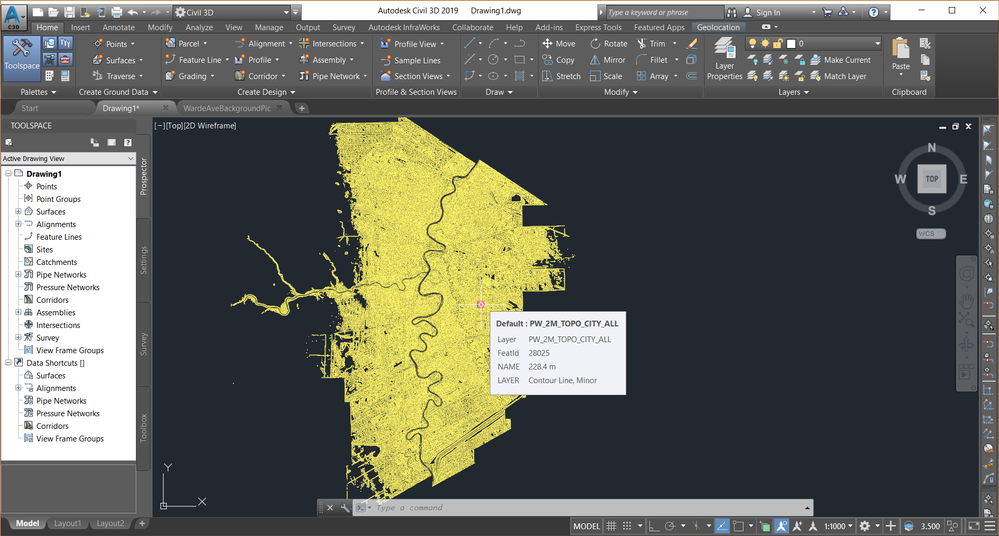
Civil3D is a software tool for civil engineers that helps in the design and analysis of infrastructure projects such as roads, highways, and land development. Civil3D works seamlessly with other applications in the collection to allow for connected design in infrastructure projects.
Revit is a software tool for architects and engineers that allows for the creation of detailed building models. Revit can import Civil3D data, allowing architects to see how buildings interact with the surrounding infrastructure.
Autodesk Docs is a cloud-based document management system that enables teams to collaborate on project documentation in real-time. Civil engineers can use Autodesk Docs to manage project documentation, including design plans, construction schedules, and specifications.
InfraWorks is a software tool that allows for the creation of 3D models of infrastructure projects. Civil engineers can use InfraWorks to visualize the impact of infrastructure projects on the surrounding environment. InfraWorks can also import data from Civil3D, enabling the creation of detailed 3D models of infrastructure projects.
Connected design offers several benefits for civil engineers and infrastructure projects. Let’s explore some of these benefits in more detail.
Improved Collaboration
One of the main benefits of connected design is improved collaboration between engineers and other members of the project team. By using software tools like Civil3D, Revit, Autodesk Docs, and InfraWorks, engineers can work together in real-time to make changes and updates to the model. This collaborative approach can lead to more efficient and effective decision-making, which can ultimately save time and reduce errors in the design process. Connected design also allows for better communication between team members, as everyone has access to the same data and can easily share their ideas and feedback.
Streamlined Design Process Connected design also streamlines the design process for civil engineers. With software tools like Civil3D, engineers can create accurate and detailed 3D models of their designs, which can be easily imported into other applications like Revit and InfraWorks. This integration between different software tools eliminates the need for manual data transfer, which can be time-consuming and error-prone. The streamlined design process also allows for faster iteration and decision-making, as engineers can quickly make changes and updates to the model based on feedback from other team members.
More Accurate and Detailed Modeling
Connected design enables civil engineers to create more accurate and detailed models of their designs. With software tools like Civil3D, engineers can create 3D models that accurately represent the real-world conditions of the project site. This level of detail allows engineers to analyze and test their designs more thoroughly, which can help identify potential issues and prevent costly mistakes during construction. More accurate and detailed modeling also enables engineers to optimize their designs for efficiency, reducing the overall cost and environmental impact of the project.
Better Data Management Connected design also provides better data management for civil engineers. With software tools like Autodesk Docs, engineers can store and manage all project data in one central location. This eliminates the need for manual data transfer and ensures that all team members have access to the most up-to-date information. Better data management also enables engineers to track changes and updates to the design over time, which can be helpful for future maintenance and repairs.
Enhanced Visualisation
Finally, connected design enables enhanced visualization for civil engineers. With software tools like InfraWorks, engineers can create 3D models of entire cities and infrastructure projects, which can be used to visualize the impact of the project on the surrounding environment. Enhanced visualization can also be helpful for presenting designs to stakeholders and the public, as it provides a clear and detailed representation of the project.
Civil 3D, InfraWorks, and Revit are all part of the Autodesk Architecture, Engineering, and Construction (AEC) industry collection, and are designed to work together for connected design workflows.
InfraWorks is used for creating and visualizing large-scale infrastructure projects, such as roads, highways, and airports. It provides tools for creating 3D models of proposed designs, analyzing the impacts of these designs on the surrounding environment, and sharing and collaborating with other stakeholders.
Civil 3D, on the other hand, is focused on detailed civil engineering design, such as grading, drainage, and road design. It allows for the creation of detailed design models, analysis of earthwork quantities, and the creation of construction documentation.
Revit is a BIM software that provides tools for creating and managing detailed 3D models of buildings and structures. It can be used to create and analyze structural designs, as well as to manage building information throughout the design and construction process.
When used together, these tools enable a connected design workflow that allows for the creation and analysis of both the infrastructure and the buildings and structures that will be integrated into it. InfraWorks can be used to create a preliminary design of the infrastructure project, which can then be imported into Civil 3D for detailed design and analysis. Revit models can also be integrated into the design process, allowing for the creation of detailed building information models that can be analyzed in the context of the surrounding infrastructure.
Overall, the connected design workflow enabled by these tools allows for greater collaboration and efficiency throughout the design and construction process, leading to better outcomes for infrastructure projects.
AutoCAD is a general-purpose CAD software used for 2D drafting and 3D modeling, whereas Civil 3D is specifically designed for civil engineering tasks such as road design and land development. Revit is a BIM software used for building design and construction documentation. While AutoCAD and Civil 3D are more focused on geometric design, Revit allows for the creation of detailed 3D models with parametric design features. Civil 3D and Revit also offer collaboration features such as cloud-based sharing and real-time updates, which are not available in AutoCAD. The choice between these software depends on the specific needs and tasks of the project.
| Features | AutoCAD | Civil 3D | Revit |
|---|---|---|---|
| 2D Drafting | Yes | No | Yes |
| 3D Modeling | Yes | Yes | Yes |
| Geometric Design | Yes | Yes | Limited |
| Civil Engineering Design | No | Yes | Yes |
| Road Design | No | Yes | Limited |
| Land Development | No | Yes | Limited |
| BIM Features | No | No | Yes |
| Parametric Design | No | No | Yes |
| Cloud-Based Sharing | No | Yes | Yes |
| Real-Time Updates | No | Yes | Yes |
| Bridge Design | No | Yes | Yes |
| Topography | No | Yes | Yes |
| Civil Structural Engineering | No | Yes | Yes |
Civil 3D and InfraWorks are both part of the Autodesk AEC industry collection and are commonly used for civil engineering and infrastructure design projects. While they share some similarities, they have distinct differences in terms of their focus and capabilities.
Civil 3D is primarily focused on detailed design for civil engineering projects, such as grading, drainage, and road design. It is a powerful tool for creating accurate 3D models of proposed designs and analysing earthwork quantities, as well as for creating construction documentation. Civil 3D is ideal for engineers who need precise control over the design process and require a high level of detail and accuracy.
InfraWorks, on the other hand, is focused on conceptual design and visualization for large-scale infrastructure projects, such as highways, airports, and rail networks. It provides tools for creating 3D models of proposed designs, analyzing the impacts of these designs on the surrounding environment, and sharing and collaborating with other stakeholders. InfraWorks is ideal for early-stage design, where the focus is on understanding the potential impacts of a project and communicating that information to stakeholders.
When used together, Civil 3D and InfraWorks enable a connected design workflow that allows for the creation and analysis of both the detailed civil engineering design and the larger-scale infrastructure design. Civil 3D can be used to create detailed design models, which can then be imported into InfraWorks for visualisation and analysis in the context of the surrounding environment. InfraWorks models can also be used to create preliminary designs that can be refined and detailed in Civil 3D.
A feature comparison matrix for Civil 3D and InfraWorks might include the following:
| Feature | Civil 3D | InfraWorks |
|---|---|---|
| Detailed design | Yes | No (focused on conceptual design) |
| Earthwork quantities | Yes | No |
| Terrain modeling | Yes | Yes |
| Analysis tools | Yes | Yes |
| Visualisation | Limited (focused on detailed design) | Extensive (focused on conceptual design) |
| Collaboration | Limited (focused on detailed design) | Extensive (focused on conceptual design) |
Overall, the connected design workflow enabled by Civil 3D and InfraWorks allows for greater collaboration and efficiency throughout the design and construction process, leading to better outcomes for infrastructure projects. Civil 3D is ideal for detailed design, while InfraWorks is ideal for early-stage design and visualisation.
Dynamo for Civil 3D is a powerful tool that allows users to automate complex design tasks and create custom workflows for Civil 3D. Dynamo is a visual programming language that can be used to create custom scripts that automate repetitive design tasks, such as creating road alignments, profiles, and surfaces.
With Dynamo, Civil 3D users can create custom tools and workflows that are tailored to their specific project needs. For example, users can create scripts that automatically generate designs based on predefined parameters, or scripts that analyze and optimize designs for cost and efficiency.
The use of Dynamo for Civil 3D can significantly streamline the design process, reduce errors, and improve project outcomes. By automating repetitive tasks, engineers and designers can focus on higher-level design decisions and creative problem-solving.
The Autodesk Architecture Engineering and Construction Collection is a powerful suite of software programs that can help architects create better designs and collaborate more effectively with other professionals in the construction industry. By using programs such as Revit, Navisworks, and Docs, architects can create digital models of buildings and share them with other stakeholders, streamlining the design process and reducing errors. By collaborating with MEP/HVAC, Structural and Civil engineers and designers, architects can ensure that their designs are not only visually appealing but also practical and functional, resulting in better-performing buildings that meet safety and regulatory requirements.
Discover how Autodesk Architecture Engineering and Construction Collection can streamline your workflow, increase productivity, and optimise your design process.
Contact us to find out how much money you can save on software, training or other services. Fill out the form below, by live chat, phone or email.
P: 1800 490 514 | E: info@designconsulting.com.au
Click a link below to learn more about Connected Design using the Autodesk Product Design & Manufacturing Collection
What To Get And Why. A CAD user’s workflow generally falls into 2 categories, modeling and simulation and getting a CAD workstation to suit your requirement is essential. While getting something better than what you need will delay the need to buy another computer down the track, getting something less than required will end up costing more than the…